
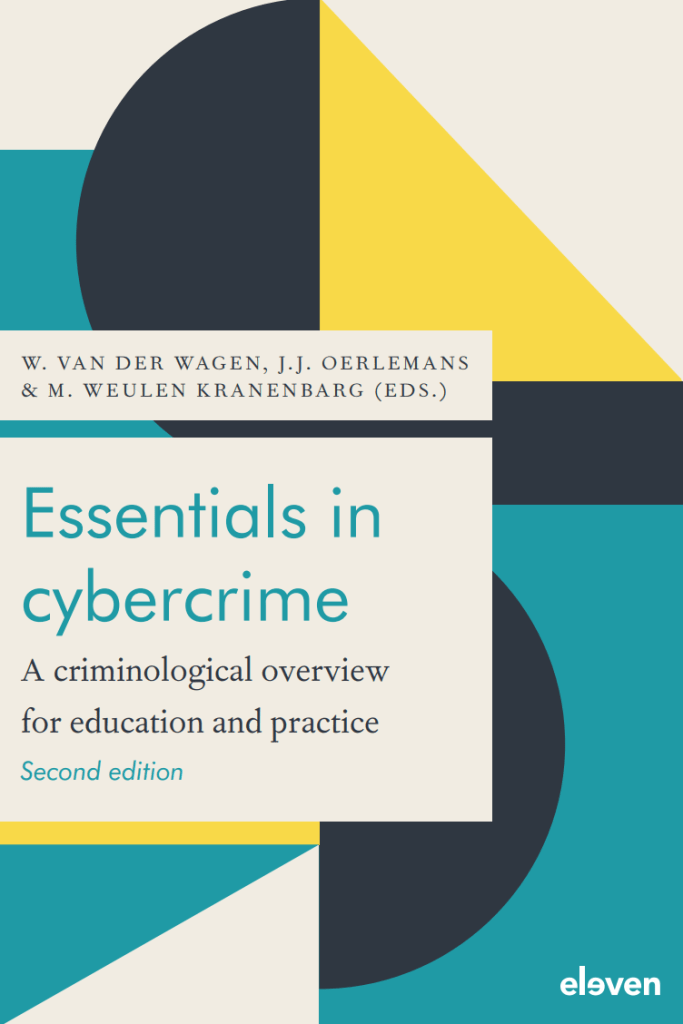
The chapters ‘Types of cyber-dependent crime and their criminalisation’ (.pdf), Types of cyber-enabled crime and their criminalisation (.pdf), and ‘Cybercrime investigations’ (.pdf)) are now available in open access.
In this second edition, we chose to address cyber-dependent and cyber-enabled crime in separate chapters, allowing for more detailed discussion of both categories. A new section has been added on online expression offenses, with a particular focus on European legislation—an important topic that was missing from the previous edition. Additionally, recent developments such as generative AI and Large Language Models are given significant attention.
Other chapters are not available in open access, but cover a range of topics including cybercrime offenders, victims, criminal networks, criminological theories, and intervention strategies. The full book is available for purchase via Boom.nl.
Table of contents:
Chapter 3 – Types of cyber-dependent crime and their criminalisation
Jan-Jaap Oerlemans, Wytske van der Wagen & Marleen Weulen Kranenbarg
3.1 Introduction
3.2 Cyber-dependent crime and its criminalisation
3.3 Computer hacking
3.3.1 Criminalisation
3.3.2 Ethical hacking
3.4 Malware
3.4.1 Info-stealers
3.4.2 Ransomware
3.4.3 Banking malware
3.4.4 Criminalisation
3.5 Botnet
3.5.1 Criminalisation
3.6 Ddos attack
3.6.1 Criminalisation
3.7 The role of social engineering in cybercrime
3.7.1 Six principles of persuasion
3.8 Future developments
3.8.1 Greater influence of state actors
3.8.2 The Internet of Things
3.9 To conclude
3.10 Discussion questions
3.11 Key concepts
Please cite as:
- Oerlemans J.., Wagen W. van der & Weulen Kranenbarg M. (2024), Types of cyber-dependent crime and their criminalisation. In: Wagen W. van der, Oerlemans J. & Weulen Kranenbarg M. (Eds.), Essentials in cybercrime: a criminological overview for education and practice. The Hague: Eleven. 63-95.
Chapter 4 – Types of cyber-enabled crime and their criminalisation
Jan-Jaap Oerlemans, Anne de HIngh & Wytske van der Wagen
4.1 Introduction
4.2 The clear, the deep and the dark web
4.3 Online criminal marketplaces
4.3.1 Criminal marketplaces on the clear web
4.3.2 Darknet markets
4.3.3 Marketplaces on communication apps
4.3.4 Criminalisation
4.4 Money laundering with virtual currency
4.4.1 Regulation
4.4.2 Criminalisation
4.5 Online fraud
4.5.1 Criminalisation
4.6 Online sexual offences
4.6.1 Images of sexual abuse of minors
4.6.2 Sexting
4.6.3 Abuse of sexual imagery (‘revenge porn’)
4.6.4 Sextortion
4.6.5 Online grooming and sex chatting
4.7 Online expression offences
4.7.1 Freedom of expression vs. criminalisation
4.7.2 Criminalisation of online expressions
4.7.3 Removing illegal content
4.8 Future developments
4.8.1 AI and cyber-enabled crime
4.8.2 Crime in virtual reality and mixed reality worlds
4.9 To conclude
4.10 Discussion questions
4.11 Key concepts
Please cite as:
- Oerlemans J., Hingh A.E. de & Wagen W. van der (2024), Types of cyber-enabled crime and their criminalisation. In: Wagen W. van der, Oerlemans J. & Weulen Kranenbarg M. (Eds.), Essentials in cybercrime: a criminological overview for education and practice. The Hague: Eleven. 97-144.
Chapter 9 – Cybercrime investigations
Jan-Jaap Oerlemans & Maša Galič
9.1 Introduction
9.2 Digital investigations and criminal procedure law
9.2.1 Regulating investigative methods
9.2.2 Jurisdiction and cybercrime
9.2.3 Mutual legal assistance
9.3 IP addresses as digital leads
9.3.1 Data production and preservation orders
9.3.2 Seizing and analysing data on computers
9.3.3 Network computer searches
9.4 The challenge of anonymity
9.4.1 Anonymisation techniques
9.4.2 Open-source investigations
9.4.3 Online undercover operations
9.5 The challenge of encryption
9.5.1 Encryption in storage
9.5.2 Encryption in transit
9.5.3 Hacking as an investigative method
9.6 Disrupting cybercrime
9.7 To conclude
9.8 Discussion questions
9.9 Key concepts
10 Interventions for cyber offenders
Please cite as: Oerlemans J. & Galiç M. (2024), Cybercrime investigations. In: Wagen W. van der, Oerlemans J. & Weulen Kranenbarg M. (Eds.), Essentials in cybercrime: a criminological overview for education and practice. The Hague: Eleven. 257-315.
 jjoerlemans.com