
Rapporten en trends in AI en criminaliteit 2024-2025          

In de afgelopen twee jaar zijn diverse rapporten verschenen van Europol (iOCTA (2024, 2025), SOCTA 2025, AI and Policing), de Politie (over AI en fraude), samen met het Openbaar Ministerie (eerste jaarbeeld), de UNODC (rapport), de AIVD (over AI en cybersecurity), het NCSC NL (o.a. het Cybersecuritybeeld Nederland 2025) en NCSC UK (onderdeel van GHCQ) over de invloed van AI op (cyber)criminaliteit en cybersecurity.

Het valt mij in de rapporten op dat op basis van incidenten soms grote conclusies worden getrokken. Toch is het belangrijk om de gesignaleerde trends op een rij te zetten. In deze blog vat ik daarom een aantal van die ontwikkelingen samen. De vijf trends heb ik zelf geselecteerd. Na het lezen heb ik voor deze tekst gebruik gemaakt van Copilot Researcher en Notebook LM. Een automatisch gegenereerde podcast is hieronder te beluisteren.

1.    Verlagen van drempels voor criminaliteit en de versterking van cyberaanvallen

Criminelen zetten AI in om cyberaanvallen sneller, groter en effectiever te maken. Het Britse National Cyber Security Centre (NCSC), onderdeel van GCHQ, waarschuwde in 2024 dat AI de omvang en impact van cyberaanvallen vrijwel zeker zal vergroten in de nabije toekomst. Dit komt doordat AI de benodigde technische kennis verlaagt en aanvallen automatiseert. Zie ook de tabel op The near-term impact of AI on the cyber threat – NCSC.GOV.UK.
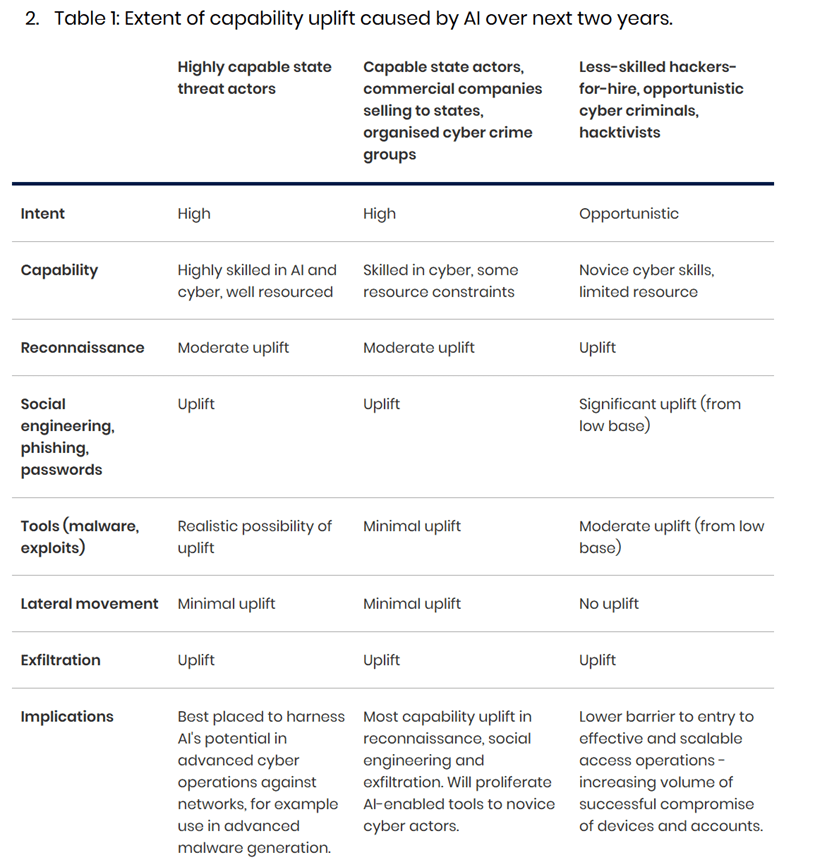
Door generatieve AI kunnen ook onervaren of minder technisch onderlegde daders geavanceerde aanvallen uitvoeren. AI-modellen genereren bijvoorbeeld phishing-teksten en malwarecode waardoor de drempel voor nieuwe cybercriminelen daalt. Fraude en kindermisbruik worden vaak expliciet genoemd als domeinen die “bijzonder waarschijnlijk” door AI-gebruik zullen intensiveren. Europol signaleerde al in 2020 dat AI kan worden ingezet voor slimme wachtwoordkrakers, CAPTCHA-bots en gerichte social-engineeringaanvallen. Deze voorspellingen zien we nu werkelijkheid worden, met steeds geavanceerdere phishingaanvallen en door AI gegenereerde malware.

Daarnaast ontstaan illegale diensten waarbij cybercriminelen generatieve AI als betaalde dienst aanbieden. Volgens NCSC UK, de Organised Crime Agency (NCA) en Europol ontwikkelen kwaadwillenden eigen AI-tools en verkopen zij ‘GenAI-as-a-service’. Deze trend sluit aan bij de eerder gesignaleerde “vermarkting” van cybercrime-tools (zoals ransomware-as-a-service) in Europol-rapporten. Ook het UNODC-rapport uit 2024 signaleert dit fenomeen voor fraude en oplichting.

De beschikbaarheid van dergelijke tools, ook in kwaadaardige varianten op het dark web zonder ‘guardrails’, verlaagt de drempel voor cyberactoren zonder diepgaande technische vaardigheden. Criminelen gebruiken LLM’s om scripts te ontwikkelen voor phishingmails of websites voor gegevensdiefstal. Het groeiende ‘phishing-as-a-service’-aanbod weerspiegelt de automatisering van deze aanvalsvector.

2.    Georganiseerde criminaliteit en AI

Veel van bovenstaande ontwikkelingen komen samen in de georganiseerde misdaad. Het SOCTA-rapport 2025 stelt dat criminelen AI als “onderdeel van hun gereedschapskist” beginnen te gebruiken. Klassieke activiteiten zoals drugshandel convergeren met cybercriminaliteit. Grote criminele groepen investeren in online fraude en datadiefstal naast hun traditionele handel. Zie eerder ook deze samenvatting van het SOCTA-rapport

Europol signaleert ook vermenging met statelijke actoren. Criminele netwerken kunnen gegevens stelen voor staten door in te breken in beveiligde systemen. Deze informatie kan worden gebruikt voor spionage, economische voordelen of chantage. Daarnaast spelen deze netwerken een sleutelrol in desinformatiecampagnes, waarbij nepaccounts, trollen en gemanipuleerde nieuwscontent worden ingezet om democratische instellingen te ondermijnen.

Criminele organisaties misbruiken corruptie om vervolging te vermijden, onder meer door het omkopen van politie en justitie. Digitale trends versterken dit fenomeen: corrupte contacten worden online geworven, betalingen verlopen via cryptovaluta, en personen met toegang tot digitale systemen zijn belangrijke doelwitten. Netwerken gebruiken versleutelde communicatieplatforms zoals EncroChat en Sky ECC, maar ook reguliere apps om te rekruteren, handelen en betalingen te regelen.

Geweld wordt steeds vaker als dienst aangeboden (‘violence-as-a-service’), gefaciliteerd door online platforms en versleutelde communicatie. Jongeren worden actief gerekruteerd voor cyberaanvallen, drugshandel en als geldezel, vaak via sociale media en met verleidelijke tactieken zoals gamificatie. Technologie speelt ook een rol in traditionele misdrijven: online werving voor mensenhandel, wapensmokkel en illegale streamingdiensten. AI en 3D-printing vergroten de toegang tot vuurwapens en maken productie van vervalste medicijnen mogelijk. Digitale piraterij en online verkoop van illegale geneesmiddelen blijven groeien, ondersteund door anonimiserings- en cryptotechnieken.

Ook de UNODC signaleert hoe online gokken, grootschalige oplichting en witwassen van cryptocurrencies samenkomen in één ecosysteem, aangejaagd door AI-tools. Dit leidt tot een “criminele dienstverleningseconomie”, waarin phishingkits, valse documenten en AI-gegenereerde propaganda worden verhandeld. De VN noemt Zuidoost-Azië een proeftuin voor AI-gedreven criminaliteit. Scam-centra rekruteren jonge mensen onder valse voorwendselen en dwingen hen om samen met AI-systemen slachtoffers op te lichten. AI automatiseert een groot deel van het werk, terwijl mensen geloofwaardige interacties onderhouden.

Ook de AIVD constateerde in 2024 (‘Versterkte dreigingen in een wereld vol kunstmatige intelligentie’ .pdf) dat AI door iedereen kan worden gebruikt voor het maken van malware en phishingberichten, wat de dreiging door niet-statelijke actoren vergroot. Het SOCTA-rapport noemt ook hoe criminele organisaties door staten worden ingezet voor sabotage van kritieke infrastructuur, informatiediefstal en cyberaanvallen. Een van de belangrijkste manieren waarop zij bijdragen, is via ransomware-aanvallen op kritieke infrastructuur, bedrijven en overheidsinstanties. Deze aanvallen genereren niet alleen financiële inkomsten – vaak via cryptovaluta – maar dienen ook om tegenstanders te ontwrichten door essentiële diensten lam te leggen, chaos te creëren en het vertrouwen van het publiek te ondermijnen.

Een concreet voorbeeld is de cyberaanval op de Nationale Politie in september 2024 door de waarschijnlijk staatsgesteunde Russische groep LAUNDRY BEAR (zie deze advisory report .pdf).

LAUNDRY BEAR richt zich, net als andere Russische cyberdreigingsactoren, voornamelijk op landen die lid zijn van de EU of NAVO. De groep valt vooral organisaties aan die relevant zijn voor de Russische oorlogsinspanningen in Oekraïne, zoals defensieministeries, krijgsmachtonderdelen, defensiebedrijven en EU-instellingen. Ook ministeries van Buitenlandse Zaken en andere overheidsorganisaties behoren tot de doelwitten. Naast Europa zijn er aanvallen waargenomen in Oost- en Centraal-Azië. In 2024 voerde LAUNDRY BEAR aanvallen uit op defensiecontractanten, luchtvaartbedrijven en hightech ondernemingen, waarschijnlijk om gevoelige informatie te verkrijgen over wapenproductie en leveringen aan Oekraïne. De groep lijkt kennis te hebben van militaire productieprocessen en probeert technologieën te bemachtigen die door sancties moeilijk toegankelijk zijn.

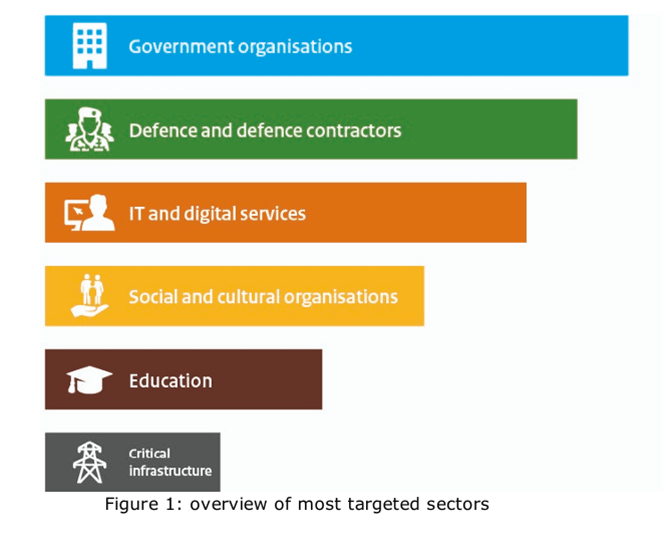
Naast militaire en overheidsdoelen richt LAUNDRY BEAR zich ook op civiele organisaties en commerciële bedrijven, vooral in de IT- en digitale dienstensector. Deze netwerken bieden vaak indirecte toegang tot overheidsinformatie, waardoor ze aantrekkelijk zijn voor spionage. Verder zijn aanvallen vastgesteld op NGO’s, politieke partijen, media, onderwijsinstellingen en kritieke infrastructuur, vrijwel zeker met spionagedoeleinden. In vergelijking met andere Russische actoren heeft LAUNDRY BEAR een hoge succesgraad. De meest getroffen sectoren zijn: overheidsorganisaties, defensie en defensiecontractanten, IT- en digitale diensten, sociale en culturele organisaties, onderwijs en kritieke infrastructuur.
3.    AI in fraude en oplichting

Criminelen misbruiken deepfakevideo’s, -audio en -afbeeldingen om vertrouwen te winnen of druk uit te oefenen. Europol waarschuwde in 2022 dat deepfakes een “standaardtool voor georganiseerde misdaad” dreigen te worden. Voorbeelden zijn CEO-fraude (waarbij een vervalste stem of video van een leidinggevende ondergeschikten instrueert geld over te maken), vervalsing van bewijs en productie van niet-consensueel seksueel materiaal.

LLM’s versnellen aanvalsvoorbereiding door automatisch grote hoeveelheden informatie over doelwitten te verzamelen. Ze genereren foutloze phishingmails in meerdere talen en imiteren schrijfstijlen, wat spearphishing veel geloofwaardiger maakt.

Een concrete toepassing is het creëren van synthetische identiteiten met AI. Criminelen gebruiken AI-gegenereerde gezichten en stemmen om zich voor te doen als betrouwbare derden – bijvoorbeeld als helpdeskmedewerker, bankmedewerker of bekende van het slachtoffer. Voice cloning (het klonen van stemmen) is dermate geavanceerd dat in enkele gevallen in 2023–2024 bedrijfsmedewerkers zijn opgelicht door een telefoontje dat klonk als hun directeur, waarin om een spoedoverboeking werd gevraagd. Uit het UNODC-rapport blijkt ook dat ze geloofwaardige valse identiteitsdocumenten of profielfoto’s genereren om verificaties te omzeilen. Dit omvat bijvoorbeeld AI-gedreven ‘identity masking’, waarbij online profileren automatisch worden gerouleerd, deepfake-video’s worden gebruikt tijdens illegale transacties, of het foppen van biometrische toegangscontroles.

Dankzij AI kunnen fraudeurs hun aanpak beter afstemmen op hun doelwitten. Tools kunnen enorme datasets doorzoeken (OSINT) en patronen herkennen om bijvoorbeeld overtuigende persoonlijke babbels of op maat gemaakte phishing-mails te genereren. De Nederlandse politie verwacht dat social engineering-aanvallen de komende jaren verder verfijnd en grootschaliger worden door AI. In het Fenomeenbeeld Online Fraude 2024 wordt expliciet vermeld dat de trend van steeds gerichtere benadering van slachtoffers “vermoedelijk zal versnellen onder invloed van kunstmatige intelligentie”.

Uit een andere analyse van het United Nations Office on Drugs and Crime (UNODC 2024) blijkt dat criminele fraudenetwerken in Zuidoost-Azië op grote schaal AI inzetten om slachtoffers wereldwijd te bereiken. De onderzoekers zagen een stijging van meer dan 600% van deepfake-content op criminele fora in de eerste helft van 2024 vergeleken met eerdere periodes. Zij combineren bijvoorbeeld gescripte chatbots met deepfake-profielen om geloofwaardige gesprekken te voeren in meerdere talen.

4.    AI en seksuele uitbuiting

Een van de meest verontrustende ontwikkelingen sinds 2023 is het gebruik van AI voor het produceren van seksueel materiaal van minderjarigen (ook wel: materiaal van seksueel misbruik van kinderen (CSAM).

Sinds 2023 neemt het gebruik van AI voor het produceren van seksueel materiaal van minderjarigen sterk toe. Politie en opsporingsinstanties zien een duidelijke stijging van AI-gegenereerde afbeeldingen en video’s van kindermisbruik. In Nederland meldde de politie in 2024 dat dit materiaal “steeds vaker opduikt” in onderzoeken. Rechercheurs besteden veel tijd aan het vaststellen of een afbeelding echt is of door AI is gemaakt, wat capaciteit wegneemt van het bestrijden van daadwerkelijk misbruik.

Europol bevestigt deze trend in het iOCTA-rapport 2024: volledig synthetische of door AI gemanipuleerde CSAM vormt een opkomende dreiging.

iOCTA rapport van 2024 op Europees niveau: volledig synthetische of door AI gemanipuleerde CSAM komt steeds vaker voor. ‘Operation Cumberland’ illustreert dit: wereldwijd werden ~270 kopers geïdentificeerd en diverse arrestaties verricht. De Nederlandse politie voerde met vier geïdentificeerde kopers waarschuwingsgesprekken om herhaling te voorkomen.

Nederlandse en internationale politiediensten maken daarbij geen onderscheid in echte of met AI gegenereerde CSAM.  Dit is niet alleen omdat de impact (normalisering van misbruikfantasieën) ernstig is, maar ook omdat voor de training van zulke AI vaak echte misbruikbeelden worden gebruikt.

5.    Prompt injection attacks

De NCSC UK legt uit dat ‘prompt injection’ een relatief nieuwe kwetsbaarheid is in generatieve AI-toepassingen (ontstaan in 2022). Het treedt op wanneer ontwikkelaars eigen instructies combineren met onbetrouwbare inhoud in één prompt en aannemen dat er een duidelijke scheiding bestaat tussen ‘wat de app vraagt’ en externe data.

In werkelijkheid maken LLM’s geen onderscheid tussen data en instructies; ze voorspellen simpelweg het volgende token. Hierdoor kan een aanvaller via indirecte prompt injection – bijvoorbeeld door verborgen tekst in een CV – het model ongewenste acties laten uitvoeren. Dit maakt prompt injection fundamenteel anders dan klassieke kwetsbaarheden zoals SQL-injectie, waarbij mitigaties zoals parameterized queries effectief zijn.

De NCSC adviseert om prompt injection niet te zien als code-injectie, maar als exploitatie van een ‘inherently confusable deputy’. Ontwikkelaars moeten systemen zo ontwerpen dat ze geen privileges blindelings doorgeven aan LLM’s. Dit betekent: toegang tot gevoelige tools beperken, deterministische beveiligingslagen toepassen en invoer, uitvoer en mislukte API-calls monitoren. Volledige preventie lijkt onhaalbaar, maar het verkleinen van kans en impact is essentieel. Zonder maatregelen dreigt prompt injection dezelfde golf van incidenten te veroorzaken als SQL-injectie in het verleden.

EU SOCTA report 2025 – The changing DNA of serious and organised crime

On 12 March 2025, Europol published its latest EU Serious and Organised Crime Threat Assessment (EU SOCTA) report (.pdf). The report immediately caught my attention, as it highlights how the DNA of serious and organised crime is evolving due to several key factors:

  1. Increasing entanglement between organised crime and state actors, leading to ‘hybrid threats’ that destabilise society.
  2. The growing role of the internet and digital communication tools in facilitating more traditional criminal activities.
  3. The acceleration of crime through emerging technologies such as artificial intelligence, which grant criminal networks new capabilities.

Europol concludes that these developments are transforming the tools, tactics, and structures employed by criminal organisations. This is reflected in the title of the report: ‘The changing DNA of serious and organised crime’.

This blog provides a summary of the report’s findings, particularly focusing on the intersection between organised crime and technology. Additionally, I have created a podcast on this topic with Notebook LM, and a Dutch version is available in .pdf format. The first episode of the official podcast by Europol is also about this report.

The EU SOCTA report identifies key threats to serious and organised crime in Europe. These threats include cyber-attacks, online fraud schemes, (online) child sexual exploitation, migrant smuggling, drug trafficking, firearms trafficking, and waste crime. The key threats encompass both crimes predominantly occurring in the digital and online realm, as well as more traditional crime areas involving physical trafficking and illicit cross-border activity. This summary focusses on crimes with a clear connection to the digital and online realm, following the same structure as the report.

1. Hybridisation of Organised Crime: Destabilising Society?

According to Europol, serious and organised crime has a dual destabilising effect on the EU and its Member States. It undermines and reduces trust in the EU’s economy, the rule of law, and society as a whole by generating illicit proceeds, spreading violence, and normalising corruption.

Hybrid threats

Criminal networks may be influenced by state actors and may target democratic processes, social cohesion, public security, or the rule of law. In some cases, it may also impact financial stability and economic prosperity. These are called ‘hybrid threats’ in the report.

Some states even provide safe havens for criminals in exchange for the services of criminals, allowing them to operate with impunity. This enables states to outsource crimes such as cyber-attacks, disinformation campaigns, and money laundering, making attribution more difficult.

Ransomware

Criminal networks contribute to hybrid threats through ransomware attacks on critical infrastructure, businesses, and government agencies. These attacks generate financial profits—often through cryptocurrency payments—while also disrupting services and undermining public trust.

Europol notes that ransomware attacks are becoming more targeted, focusing on private industries, critical infrastructure, and small-to-medium-sized businesses. Additionally, there has been a growing number of supply chain attacks. The ransomware landscape is also evolving due to law enforcement interventions, leading to fragmentation and rebranding of criminal groups.

Cyberespionage and desinformation

Criminal networks can also steal data on behalf of hybrid threat actors. By infiltrating secure systems, they might steal data of strategic importance for governance or business and provide hybrid threat actors with invaluable information that can be used for espionage, economic advantage, or even coercion.

Additionally, these networks are instrumental for propaganda campaigns aimed at spreading disinformation and influencing political systems. These networks can play a key role in disinformation campaigns, using fake social media accounts, coordinated troll operations, and manipulated news content to weaken democratic institutions from within.

Corruption

Criminal networks exploit corruption to secure protection from prosecution by trying to bribe law enforcement and the judiciary. This enables them to avoid arrests, obstruct investigations, and manipulate legal proceedings in their favour. Additionally, corrupt officials may provide criminals with classified information regarding operations, allowing them to evade detection and continue their activities with impunity. Beyond law enforcement and judiciary, public institutions are highly susceptible to infiltration by criminal networks.

Europol explains that corruption has adapted to the broader trends toward digitalisation and a crime-as-a-service model. Several issues become increasingly visible: the targeting of individuals with access to digital systems in public and private entities, the use of digital recruitment tactics, and the elevated role of corruption brokers. The recruitment of, and communication with corruptees takes place online. Bribes are transferred by criminally exploiting cryptocurrencies or fintech. In addition, individuals with access to digital systems become key targets for corruption as they can provide access to information relevant to the criminal enterprise.

2. Digitalisation of organised crime

Europol states that:

“Today, nearly all forms of serious and organised crime have a digital footprint.”

Criminal networks exploit digital infrastructure for recruitment, trade, and financial transactions. They use encrypted messaging apps to communicate, recruit members (including minors), and advertise illicit goods and services. These networks employ technical specialists to enhance their operations and evade law enforcement detection.

Europol identifies two primary forms of encrypted communication:

1. Dedicated criminal platforms – Platforms such as EncroChat, Sky ECC, Ghost and others provided a communication environment for serious and organised crime. Such systems are designed to provide an end-to-end encryption that prevents external interception

2. Mainstream communication tools – Criminals abuse end-to-end encrypted communication services, which are legally designed to protect users’ privacy. These over-the-top communication applications provide legitimate encryption, large user bases that allow criminals to blend in with ordinary users. Unlike the first category, these platforms or tools are not built for criminals, making it necessary for law enforcement to engage with private companies, navigate legal frameworks to investigate and disrupt criminal networks operating within them.

Recruitment and violence

Organised crime-related violence has intensified in certain regions, particularly in urban drug markets and port cities. Criminals use online platforms to recruit hitmen and coordinate violent attacks. Violence is now increasingly offered as a service and made possible by the availability of trafficked weapons.

Within criminal networks, low-ranking members commonly act as perpetrators, but violence is also outsourced to young perpetrators, assorted criminals, and professional hitmen or hit squads offering violence-as-a-service. They are contacted directly through a network of personal contacts, in prisons, or via intermediary contacts. Encrypted communications and online platforms are instrumental in finding and recruiting these executors.

Young perpetrators

Europol finds the involvement of young perpetrators in violent crimes of particular concern. The recruitment of young perpetrators, including young adolescents and children, into serious and organised crime and terrorism is not a new phenomenon. However, it has increasingly become a means used by criminal networks to remain out of reach of law enforcement and the judiciary.

Young perpetrators are frequently exploited in several criminal markets and in several roles. In cyber-attacks, script kiddies are influenced to conduct specific cyberactivities for a fee. In drug trafficking, young people are recruited in roles like dealers or couriers but also warehouse operators, and drug extractors from shipping containers. Young people are used as money mules, receiving and transferring illicit funds through their bank accounts, often in exchange for a small share of the money.

These young perpetrators are recruited through social media platforms and messaging applications, exploiting the anonymity and encryption they offer. Criminals use tactics to lure young people, including tailored language, coded communication, and gamification strategies. By glorifying a luxurious and violent lifestyle, they convince vulnerable young people to join their ranks.

3. The Role of Technology in Other Crimes

Europol’s report reveals surprising connections between technology and traditional crimes like human trafficking and firearms smuggling. For example, criminal networks use the internet to recruit victims, advertise illicit services, and exchange funds electronically. They also circulate forged identity documents online to facilitate trafficking.

AI and 3D printing technologies are increasing access to illicit firearms and enhancing weapon modification techniques. Encrypted communication platforms are expected to play a growing role in the trafficking of firearms and explosives.

Digital content piracy

Europol explains that the current cost-of-living crisis as well as the fragmentation of content across multiple legal streaming platforms prompt consumers to seek more cost-effective and unified packages regardless of their illegality.

Criminal networks often lease servers from legitimate hosting provider companies to ensure the anonymity and scalability of their operations. Others establish their own servers which may be outsourced to other criminal networks as a service. The increased use of anonymisation tools such as VPNs to avoid server blocks ordered by judicial or law enforcement authorities will continue to be a default modus operandi. Criminal actors also rely on a variety of professional expertise, mainly associated to information technology (IT) services such as technicians who build, operate and optimise the software and digital infrastructure for illegal streaming.

Digital pirates may also steal or purchase login credentials from legitimate subscribers — often sourced via phishing scams or data breaches — and then repackage multiple over-thetop libraries into a single, unauthorized service. They often use specialised software or devices to intercept and record live or on-demand streams, relaying the pirated content through internet protocol television (IPTV) servers or file-sharing platforms.

Online pharmaceuticals

Online platforms facilitate the sale of counterfeit falsified, substandard or fraudulently obtained legitimate medicines. These are often paid with cryptocurrencies, and the pharmaceuticals are delivered by postal and parcel services.

AI and technological advancements, including 3D printing, will continue to be leveraged by criminal networks to manufacture tablets.

4. Emerging Technologies and Organised Crime

Criminal organisations are quick to adopt emerging technologies, including artificial intelligence, to enhance their operations.

An “AI fraud epidemic”?

Europol described the current online fraud landscape as follows:

The scale of online fraud, driven by advancements in automation and AI, has reached an unprecedented magnitude and is projected to continue growing. Narratives are extremely realistic, crafted with the help of AI, and incorporating trending societal topics.

The scale of online fraud, driven by advancements in automation and AI, has reached an unprecedented magnitude and is projected to continue growing. Narratives are extremely realistic, crafted with the help of AI, and incorporating trending societal topics.

Investment fraud

Investment fraud is one of the most common and growing types of online fraud, nurtured through the use of digital tools and accelerated by new technologies. The main types are Ponzi schemes, pyramid schemes, and advance fee frauds. Cryptocurrencies remain the most significant investment fraud product in the EU. While fraudsters mostly target individuals, companies are also occasionally targeted. Criminal networks have been adapting the modus operandi to the availability of digital and AI tools and to exploit new and developing markets.

Internet-enabled investment fraud is becoming more prominent than unsolicited contacts, like cold calling. Online advertisements, including social media platforms, news sites and sponsored search engine results are the main advertisement channels used by criminal networks to attract victims.

Business email compromise

In business email compromise (BEC) cases, fraudsters gain unauthorised access to the mailbox of an employee to intercept and analyse information contained in official correspondence. Once email accounts are taken over, spoofed or new versions are created. Fraudsters request payment, misleading victim by closely resembling corporate communication style and accompanying their request with well-crafted, identical falsified documents such as invoices containing modified bank accounts.

Identity theft and identity fraud are an intrinsic part of the sophisticated and targeted scheme crafted around the victim. AI, including large language models (LLMs) and deepfakes, is creating new opportunities and capabilities for criminals active in BEC. As the rapid pace of technological development continues, BEC fraud is also expected to increase. Convincing fraud emails can be easily generated with the support of LLMs, while deepfake technologies, an emerging type of impersonation replicating people’s voices, images, and videos, are now being used in CEO fraud, in which fraudsters seek to trick an organisation’s employees by impersonating their CEO.

Romance fraud

Criminal actors from around the globe are actively involved in romance fraud. Victims seeking companionship are approached on social media or dating sites by fraudsters, who impersonate individuals using fake accounts and profiles

Romance scams are expected to increase in the future, accelerated by AI tools. Voice cloning technology, deepfakes, LLM-generated scripts, and AI-driven translation will all continue to enhance fraudulent schemes, creating new fake scenarios and social engineering techniques.

A ‘transformation in child sexual exploitation material’

Child sexual exploitation and the production and distribution of child sexual abuse material (CSAM) is transforming. By creating highly realistic synthetic media, criminals are able to deceive victims, impersonate individuals and discredit or blackmail targets. The addition of AI-powered voice cloning and live video deepfakes amplifies the threat, enabling new forms of fraud, extortion, and identity theft. These tools are easily accessible and do not require specific technical skills. The accessibility of AI tools has multiplied the volume of CSAM available online, creating challenges in the analysis of imagery and identification of offenders.

Generative AI has emerged as a new means to produce CSAM, leading to growing concerns. It can support the editing of existing CSAM and the creation of new content. Explicit pictures of adults can be manipulated to make the individual look younger or applications can ‘nudify’ non-explicit images. Text-to-video models have emerged, following the rapid development of text-to-image models. Given their pace of advancement, text-to-video technology is likely to evolve just as quickly. In one of the first cases of its kind, a suspect was recently arrested for running an online platform with AI generated CSAM which he produced and shared around the world (see also this press release about ‘Operation Cumberland’)

The majority of offenders take part in online communities on the dark web and clear web, including forums, groups, and chatrooms. They discuss abuse, fantasies, how to acquire original CSAM, techniques to groom children and tips related to operational security. Offenders also use online means other than chatrooms for one-on-one interactions, with different levels of encryption and data transfer methods.

Money laundering

In the financial realm, the emergence of blockchain technology and cryptocurrencies has been leveraged to facilitate payments and launder proceeds, supported by decentralised systems and unregulated exchanges.

Cash still features prominently in money laundering schemes today. Criminals often use cash-intensive businesses—such as restaurants, hotels, car washes—to mix illicit funds with the businesses’ legitimate income. When illicit proceeds are moved physically across borders, cash is often transported via cash couriers. Increasingly, young and vulnerable people are recruited, often via social media and gaming platforms, to act as money mules.

However, the criminal exploitation of cryptocurrency as a payment method now has moved beyond the scope of cybercrime, and is encountered increasingly in more traditional crime areas such as drug trafficking or migrant smuggling.

Europol also points out a mix of digital crime and traditional crime through the report. According to Europol, professional money launderers, increasingly with specialised knowledge in digital asset trading, have developed parallel, underground financial systems that operate outside the regulatory frameworks governing legal financial institutions.

Reflection: Methodology and a Word of caution

The EU SOCTA report is based on intelligence generated by Europol analysts from data from national law enforcement agencies. While many of its findings seem to align with criminological research and Dutch court cases relating to cryptophone operations, it is important to remember that the report is not a scientific study.

At the end of the report, there is a section: “Reflection of the academic advisory group”. This group mostly praises the report, but do have one important suggestion:

“While the current approach provides significant added value to policymakers and law enforcement agencies, the inclusion of even more peer-reviewed research, established theoretical frameworks, and interdisciplinary expertise would further enhance EU-SOCTA’s analytical depth and academic rigor”.

They welcome Europol’s decision to involve the academic community in refining the methodology for the next edition.

Involving the academic community is indeed a good step and presumably a big task. Academics will look at these contents from their own perspective and knowledge base.

For example, while the academic advisory group “particularly appreciated” the chapter on hybrid threats, I found this chapter particularly weak. The underlying message of “destabilising society” is very alarming, but I don’t think it is argued well, as it lacks clear definitions, evidence thresholds, and references. Statements about “undermining democracy” or “destabilising economies” are not well substantiated, raising questions about the frequency and impact of these threats. But then again, my view is also influenced by my own perspective, experiences, and research interests 😊!

Despite this criticism and questions, the report may provide valuable and new insights to policy makers and professionals seeking to understand the digital transformation of organised crime.