Jan-Jaap Oerlemans
This is a cross-post of an article originally published on the LIMA Blog.
The article provides an English-language introduction to my mapping and dataset of 52 international cybercrime operations involving Dutch law enforcement authorities. It explains how the combined challenges of encryption, anonymity and jurisdiction have contributed to the development of infrastructure-centric, data driven policing.
This AI-generated podcast also offers an accessible discussion of my research into international cybercrime operations. The AI hosts occasionally dramatise the findings, but the podcast provides an engaging introduction to the main developments and legal questions discussed in the underlying blog post.
The original post is reproduced below.
1. Introduction
For over a decade, law enforcement authorities across Western democracies declared that they are ‘going dark’.[i] The central claim is that the widespread adoption of default end-to-end encryption (E2EE) and full-disk encryption erodes the ability of law enforcement authorities to access intercepted communications and data stored on seized devices.
In this blog post, I argue that encryption does indeed pose challenges for criminal investigations and has been an important factor in the transformation of modern investigative practices. Together with the challenges of anonymity and jurisdiction, encryption has contributed to a shift from traditional, reactive criminal investigations towards proactive, data-driven policing. As legal scholars, we should be aware of this shift and the new challenges it presents for our criminal justice systems.
This blog builds on research that I presented on 11 September 2026 at Leiden University as part of the FACE-ENIGMA project. I thank the participants for their feedback, which helped me to clarify the methodology of the empirical analysis discussed in this blog.
2. Three challenges in cybercrime investigations
Law enforcement authorities and public prosecution services within the European Union (EU) frequently publish reports on the challenges posed by encryption, anonymity and jurisdiction in cybercrime investigations.[ii] These reports make clear that the three challenges should be considered together as they can make it more difficult for law enforcement authorities to collect evidence in criminal investigations.
In practice, investigators will also face other obstacles, including organisational, financial, and cultural challenges. These are not considered in this blog post.
2.1 The challenge of encryption
To explain the challenge that encryption poses in criminal investigations, I will first briefly explain how the chronological rollout of default security protocols affected investigative practices.
Prior to 2010, large amounts of traffic on the world wide web, email, and instant messages were transmitted unencrypted over public telecommunications networks. This allowed law enforcement agencies with the necessary technical capabilities to use wiretapping techniques to intercept and interpret network traffic. From 2010 onwards, popular communication services gradually transitioned towards more secure forms of communication. Google pioneered the use of HTTPS by default for Gmail in 2010 and subsequently extended encryption to its search services between 2011 and 2013.[iii] Many other popular services, such as those of Microsoft, followed suit soon after.
In addition, device security was strengthened through the use of encryption for data at rest (i.e., ‘in storage’). In September 2014, for example, Apple released iOS 8 with full-disk encryption enabled by default. Consequently, even where law enforcement authorities lawfully seized an iPhone under a search warrant, accessing the encrypted data could prove difficult or impossible without the user’s passcode, depending on factors such as the device model, its configuration and the software version.
Over the following decade, from 2014 to 2026, full-disk encryption, secure hardware enclaves, file-based encryption and encrypted cloud backups became standard features across various operating systems. These developments made it more difficult for law enforcement authorities to access data stored on seized devices, sometimes rendering the data inaccessible.[iv]
2.2 The challenge of anonymity
Anonymity-enhancing technologies and services include virtual private networks (VPNs), compromised computers acting as proxies, The Onion Router (Tor) and its hidden services, Carrier-Grade Network Address Translation (CGNAT), and custom-built cryptophones. These technologies can conceal originating IP addresses and thereby increase users’ anonymity. In addition, the use of online handles, which is customary on internet forums, and the inability or unwillingness of online platforms to provide subscriber data linking those handles to individual users can create further obstacles for law enforcement authorities seeking to identify suspects who use computers and the internet.[v]
2.3 The challenge of jurisdiction
Jurisdiction may represent the most formidable hurdle of the three in traditional criminal investigations, particularly where a national law enforcement authority conducts an investigation and discovers that evidence or suspects are located in foreign territory. Due to the strict territorial limits placed on national enforcement jurisdiction under international law, police officers cannot execute search warrants, seize servers or deploy wiretaps in another state without its consent.
Mutual legal assistance treaties and European Investigation Orders facilitate the collection of data located in foreign territory. However, even where the requested state is obliged to provide the data, its authorities will generally have to execute the investigative measure and transmit the data to the investigating state. This may take valuable time.[vi]
Furthermore, criminal networks exploit this territorial fragmentation of law enforcement by hosting their technical infrastructure in certain countries. Some of these countries may effectively act as ‘safe havens’ where local authorities are unwilling or unable to enforce national laws, or respond effectively to international requests for cooperation. For example, non-cooperative hosting providers, also referred to as ‘bulletproof hosting providers’, may deliberately operate in jurisdictions where international legal requests are unlikely to be acted upon. Such providers may reject abuse notices and accept anonymous registrations and cryptocurrency payments.[vii]
A dead end
In practice, the challenges of encryption, anonymity and jurisdiction are intertwined and often arise at the same time. A traditional, reactive investigation that begins with cross-border requests for data through mutual legal assistance may therefore run into a dead end. Confronted with such obstacles, pioneering law enforcement authorities, including the Dutch High Tech Crime Unit (THTC), developed and refined a strategy of data-driven policing.
3. Data-driven policing
Rather than pursuing individual digital leads reactively after a crime has been reported, data-driven policing proactively targets the underlying technical infrastructure that facilitates cybercrime at scale. Data collected from this infrastructure can be analysed to identify offenders, disrupt criminal networks, support criminal investigations, and help notify or protect affected victims.
In an important conceptual paper published in 2021 and further developed in 2026, Erik van de Sandt and his co-authors formalised this operational methodology in the ‘CSAE framework’.[viii] The framework comprises four interconnected phases: Collect, Store, Analyse and Engage. In essence, this process enables law enforcement authorities to make effective use of vast amounts of unstructured data.
Phase 1: Collection
In the Collect phase, law enforcement authorities use investigative powers to acquire large amounts of data. This can be achieved through various methods, including the physical seizure of servers at data centres, covert network searches, hacking powers, the covert infiltration of technical infrastructures, and the live interception of traffic at servers or end-user devices. Rather than focusing on a single known suspect, the Collect phase deliberately, or ‘strategically’, acquires data from IT systems used to facilitate criminal activities.
Phase 2: Store
The Store phase begins with the secure storage of forensic copies of seized servers, devices or other IT systems. Relevant data, such as database tables, server logs and communications, are then extracted and, where possible, imported into digital forensic platforms. This phase may involve ‘extract, transform, and load’ processes that convert raw data into a structured and searchable format, while preserving its link to the original source.
Phase 3: Analyse
In the Analyse phase, data-science methods and qualitative investigative techniques, or ‘detective skills’, can transform the collected data into actionable intelligence. For example, information collected from a dark web market, including combinations of online handles, PGP keys, Bitcoin wallet addresses and IP logs, may be used to produce a ‘top ten’ list of vendors and expose the structure of a criminal network.
Phase 4: Engage
In the Engage phase of the CSAE model, law enforcement authorities use their unique data position to deploy a broad range of interventions. These may include: (1) prosecuting high-value targets; (2) publicly ‘naming and shaming’ vendors; (3) conducting ‘cease-and-desist’ or ‘knock-and-talk’ visits to buyers; (4) replacing seized websites with law enforcement splash pages; (5) notifying victims through portals such as ‘Check your hack’; and (6) remotely deploying malware-removal tools to disinfect victims’ devices around the world.[ix]
It is important to understand that this represents a significant departure from traditional criminal investigations and from the conventional understanding of criminal procedure, in which the primary objective is to identify a suspect and bring that person to justice. In the CSAE model, protecting victims and ‘disrupting criminal organisations’ become much more prominent objectives. Arguably, they may sometimes be even more important than the eventual prosecution of particular individuals.[x]
Of course, the CSAE framework is not entirely new. It closely resembles the intelligence cycle used to explain the processes employed by intelligence services, and it builds on theories of intelligence-led policing developed since the 1990s.[xi] However, as the examples of Dutch-led international cybercrime operations discussed below will illustrate, the framework has now been operationalised and is increasingly being used as a model for modern policing. This strategy can produce impressive results, but it also raises important legal questions.
4. Empirical research results
To examine how the CSAE framework and data-driven policing operate in practice, I conducted an empirical mapping project covering major international cybercrime operations involving Dutch law enforcement authorities between 2010 and 2026.[xii] The operations are arranged chronologically and described in narrative form on a dedicated page of my personal website. Where available, the individual webpages also refer to published case law arising from the operations.
The mapping is based primarily on press releases issued by law enforcement authorities and public prosecution services. This entails inherent methodological limitations and selection biases. The dataset reflects what these authorities choose to make public and may therefore be incomplete. Moreover, official communications understandably tend to emphasise successful results and may not provide a fully accurate account of every operation. Rather than offering an exhaustive historical record, the mapping provides an empirical window into the operational methods and evolving strategic priorities of Dutch law enforcement authorities and their international partners.
I used several digital tools to collect, organise and analyse the information. Microsoft Copilot, based on GPT-5.5, assisted in identifying relevant press releases published on politie.nl, om.nl, fiod.nl, europol.europa.eu and justice.gov. I subsequently used NotebookLM to analyse the information on the individual webpages and to help create the English-language dataset. I reviewed the resulting overview, remain responsible for any errors and welcome feedback and corrections.
In total, I identified 52 operations. These were subsequently categorised into eight operational domains:
- botnet operations;
- bulletproof hosting providers;
- darknet marketplaces;
- cryptocurrency mixing and money-laundering services;
- distributed denial-of-service (DDoS) services;
- online fraud and phishing services;
- proxy and VPN services; and
- child sexual abuse material (CSAM) platforms.
The complete results of the mapping project are presented in Table 1 below. The table lists the cybercrime categories, the associated operations and their respective years, as well as the primary operational focus and methods used to acquire data. An Excel file of the Overview of cybercrime operations can be downloaded here.
Table 1: Comprehensive mapping of international cybercrime operations involving Dutch law enforcement (2010–2026)
| Infrastructure category | Operations & year | Primary operational focus, data acquisition methods & interventions |
| 1. Botnets & droppers | Bredolab (2010), Operation Tovar / GameOver ZeuS (2014), Operation LadyBird / Emotet (2021), FluBot (2022), Operation Duck Hunt / Qakbot (2023), Operation Endgame (2024, 2025 and 2026) | Command-and-control (C2) server seizures, hacking, remote malware removal, and victim notification (‘Check je hack’) |
| 2. Bulletproof hosting services | MaxiDed (2018), CyberBunker (2019), ZServers / XHost (2025), and Hosting Provider ‘X’ (2025) | Physical server seizures, forensic imaging, and server wiretapping |
| 3. Darknetmarkets | Operation Onymous / Silk Road 2.0 (2014), Operation Bayonet / Hansa Market (2017), Wall Street Market (2019), Operation DisrupTor (2020), Operation Dark HunTor (2021), Operation SpecTor / Monopoly Market (2021–2023), Operation RapTor (2025), and Operation Deep Sentinel / Archetyp Market (2025) | Covert takeovers, infrastructure and server cloning, wiretapping, buyer and seller deanonymisation, large-scale financial and cryptocurrency seizures, infrastructure takedowns, warning messages, and public naming and shaming |
| 4. Crypto mixers & money laundering services | Bestmixer.io (2019), Tornado Cash (2022), Sinbad.io (2023), and eXch (2025) | Hacking, server wiretapping, the freezing of cryptocurrency wallets, and infrastructure takedowns |
| 5. DDoS / booter services | Netspoof (2016), Operation PowerOFF / Webstresser (2018), Operation PowerOFF continuation (2022), Operation PowerOFF continuation (2024, 2025, 2026) | Domain seizures, user database collection, buyer notifications, targeted Google advertising campaigns, knock-and-talk visits, alternative sanctions, and public-private anti-DDoS coalition warnings |
| 6. Online fraud & phishing services | WeLeakInfo (2020), Operation Tourniquet / RaidForums (2022), Raccoon Infostealer (2022), Operation Cookie Monster / Genesis Market (2023–2024), Operation Magnus / RedLine & META (2024), Operation HeartSender (2025), Operation Talent / Cracked.io & Nulled.to (2025), BidenCash (2025), VerifTools (2025), Operation Chargeback (2025), and LeakBase (2026) | Marketplace takedowns, victim notification (‘Check je hack’), buyer notifications, targeted Google advertising campaigns, and knock-and-talk visits |
| 7. Proxy & VPN services | Operation Nova / Safe-Inet VPN (2020), DoubleVPN (2021), VPNLab.net (2022), Operation Saffron / First VPN (2026), and Operation Lightning / SocksEscort (2026) | VPN server seizures, wiretapping, and the disruption of services used by ransomware operators |
| 8. CSAM platforms | Operation Rescue / Boyslover (2011), Operation Pacifier / Playpen (2015), DarkScandals (2020), Operation Cumberland (2025), Operation Stream / Kidflix (2025), and Operation Alice (2026) | Server takeovers and takedowns, international victim identification, user network deanonymisation, and coordinated global action days |
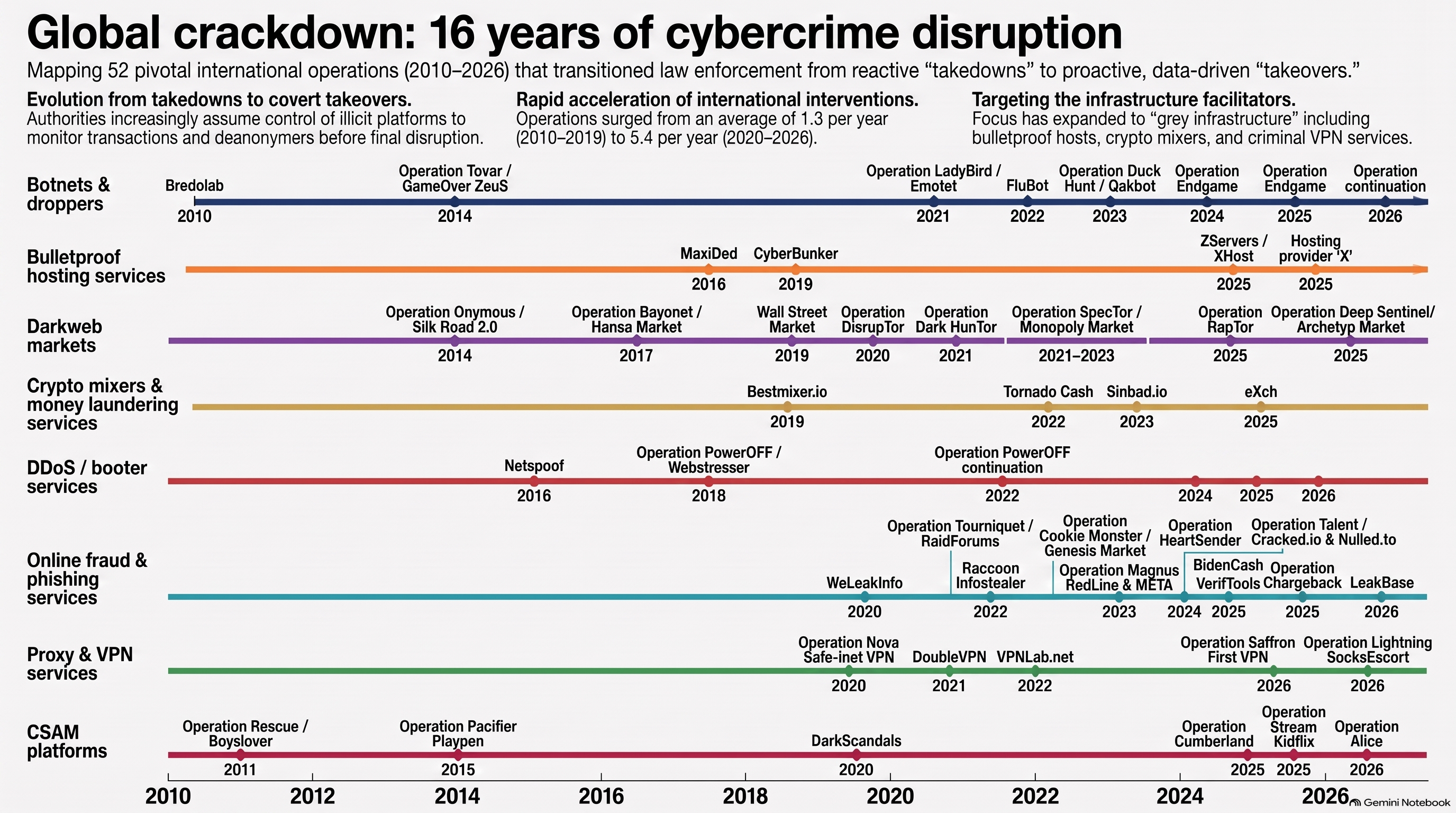
A timeline of these cybercrime operations can be viewed and downloaded below.
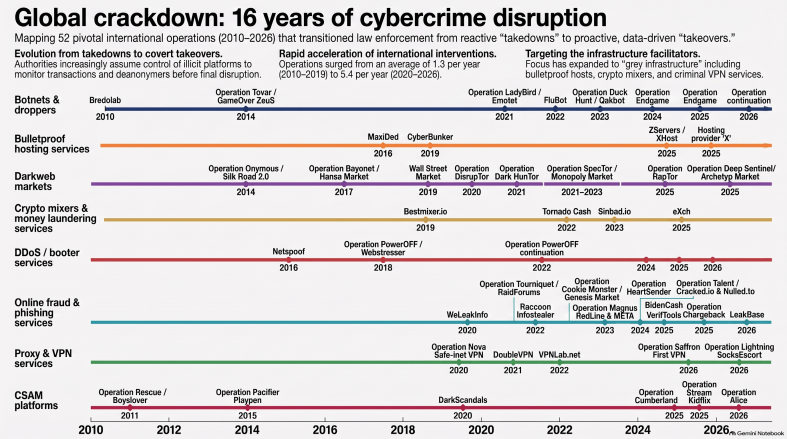
The analysis of the 52 operations mapped between 2010 and 2026 reveals four major structural developments in contemporary Dutch law enforcement practice: (1) the evolution of law enforcement strategies; (2) an infrastructure-centric approach; (3) a growing emphasis on disruption; and (4) the expansion across different cybercrime domains.
4.1 The evolution of law enforcement strategies
The empirical findings indicate a significant shift in how law enforcement authorities combat cybercrime. During the early period of cybercrime enforcement, from 2010 to 2015, operations predominantly involved reactive ‘takedowns’. A notable exception are pioneering operations involving the remote removal of malware from infected computer systems, such as the Bredolab operation. In early operations against darknet marketplaces, including Silk Road 2.0 and Operation Onymous in 2014, the primary operational objective was to dismantle server infrastructure and thereby temporarily halt online drug trading.
In the more recent period, from 2016 to 2026, the strategy developed from infrastructure takedowns towards covert infrastructure takeovers. Instead of taking services offline immediately upon gaining access to them, authorities increasingly assumed the role of digital platform administrators in order to maximise intelligence gathering.[xiii] This shift can be observed across several operational domains:
- Darknet marketplaces: In Operation Bayonet (2017), Dutch law enforcement authorities secretly took over and administered Hansa Market for 27 days following the arrest of its German operators. They copied and monitored the server environment, recording more than 50,000 transactions and intercepting unencrypted delivery addresses.
- Illegal-content platforms: In Operation Pacifier (2015), the FBI seized the Tor hidden service Playpen and operated it from a government facility for 13 days while using hacking techniques to identify users.
- Botnet infrastructure: In Operation Duck Hunt (2023), law enforcement authorities seized Qakbot’s command-and-control servers and remotely deployed an uninstaller to approximately 700,000 infected computers worldwide.
Although this proactive takeover model can significantly increase the operational reach of law enforcement and the volume of data acquired, it also raises complex questions of criminal procedure and fundamental rights. These include the scope of judicial authorisation for investigative powers, jurisdictional limits, data protection requirements and safeguards against entrapment.[xiv]
4.2 An infrastructure-centric approach
The results show that Dutch law enforcement authorities increasingly focus on the technical infrastructures that enable cybercrime, rather than limiting their investigations to individual offenders. By seizing or infiltrating core infrastructures, such as those operated by illicit online marketplaces, authorities can obtain large datasets. Examples include the infrastructure of CyberBunker (2019), ZServers/XHost (2025), Hansa Market (2017) and Genesis Market (2023). The resulting datasets may contain large volumes of financial transactions, server logs and communications relating to thousands, tens of thousands or, in some cases, millions of users.[xv]
Because the dataset covers operations involving Dutch law enforcement authorities, it primarily reflects the international cooperation network of the Netherlands rather than global enforcement trends as a whole. Nevertheless, the data reveal a highly consistent and increasingly institutionalised coalition of law enforcement partners. The vast majority of the complex operations in the dataset, 49 out of 52, were conducted in close coordination with a relatively small group of international partners over the 16-year period from 2010 to 2026.
The principal partners include Europol, which provides operational coordination and intelligence analysis through the European Cybercrime Centre (EC3) and the Joint Cybercrime Action Taskforce (J-CAT), the US Federal Bureau of Investigation (FBI), the German Bundeskriminalamt (BKA), the UK National Crime Agency (NCA) and, more recently, French law enforcement authorities. This recurring coalition suggests that transnational, data-driven policing depends on a network of partners with the technical, financial and organisational capacity to carry out synchronised, cross-border interventions against criminal infrastructure.
4.3 The movement towards disruption
The third trend is that cybercrime operations increasingly move from prosecution towards disruption. Although arrests and formal charges remain important objectives, they are not always prominent in official communications about these operations. In several major operations, including Netspoof (2016), Operation Duck Hunt/Qakbot (2023) and Bulletproof Hosting Provider ‘X’ (2025), official law enforcement communications reported no arrests on the main action day. Instead, they focused on taking down infrastructure, securing data and limiting further harm.
An equally significant objective appears to be the use of disruptive interventions designed to destabilise illicit markets, increase the perceived risks of participation and influence user behaviour. These interventions can be divided into two main categories:
- Strategic communication and deterrence. Law enforcement authorities actively seek to undermine trust and create friction within underground communities. They may display public countdown timers on seized domains to create uncertainty before further action, as seen most visibly in Operation Endgame (2024–2026) and Operation Cronos/LockBit (2024). Once the infrastructure has been secured, authorities frequently replace illicit platforms with official takeover banners or splash pages to demonstrate that users’ activities may no longer be anonymous. Examples include Operation Cookie Monster/Genesis Market (2023–2024), Operation Tourniquet/RaidForums (2022) and LeakBase (2026).
Law enforcement authorities also publish video messages and warnings on dedicated websites, including operation-endgame.com, operation-magnus.com and operation-saffron.eu. Their engagement may extend to messaging services such as Telegram. During Operation Endgame, for example, authorities established official Telegram channels to request information from the public. In Operation Magnus (2024), authorities disrupted supply chains by closing trading groups and administrator accounts on Telegram. Dutch police have also taken control of illicit channels to send warnings to registered members and inform them that their user details have been recorded in police databases.[xvi]
- Victim assistance and interventions directed at buyers. Data obtained from seized infrastructure are also used to identify and notify victims and to provide tools for removing malware or restoring access to encrypted files. Dutch law enforcement authorities have, for example, processed hacked or leaked data for use in the public verification portal Check je hack. Decryption keys and related assistance are also made available through the No More Ransom platform.
On the offender side, authorities may issue cease-and-desist warnings by email or Telegram, or conduct physical ‘knock-and-talk’ visits to registered buyers of illicit tools. Examples include Operation Cookie Monster/Genesis Market (2023–2024), VerifTools (2025) and the Operation PowerOFF series (2018–2026).
This development illustrates a move beyond a purely punitive model of criminal justice towards market disruption, harm reduction, increased risk perception and behavioural deterrence.
However, from a legal perspectiveit may also expose important gaps in the traditional framework of criminal procedure. Procedural safeguards and defence rights under Article 6 ECHR are generally associated with the determination of a criminal charge. When law enforcement authorities use bulk data to impose disruptive interventions or measures resembling informal sanctions outside formal criminal proceedings, individuals may be identified, warned or otherwise targeted without judicial proceedings.
4.4. Expansion across cybercrime domains
Finally, the dataset illustrates a gradual horizontal expansion of data-driven policing across different forms of cybercrime. Law enforcement authorities have progressively adapted this methodology to target fraudulent marketplaces, financial facilitators and networks distributing illegal content.
The chronological overview does not reveal a strictly linear development. Nevertheless, several broader developments can be observed. Early operations demonstrated the feasibility of seizing or taking control of central infrastructure, particularly in investigations involving botnets and CSAM platforms. Pioneering operations such as Bredolab (2010) and Operation Tovar/GameOver ZeuS (2014) demonstrated the technical feasibility of seizing central command-and-control servers and redirecting, or ‘sinkholing’, network traffic to disrupt malware distribution.
At the same time, early CSAM investigations, most notably Operation Rescue/Boyslover (2011) and Operation Pacifier/Playpen (2015), demonstrated that the seizure or takeover of central server infrastructure, combined in some cases with hacking techniques, could yield large datasets for identifying victims and users around the world. This approach was subsequently used in coordinated international operations against streaming services and forum-based platforms, including DarkScandals (2020), Operation Cumberland (2025), Operation Stream/Kidflix (2025), and Operation Alice (2026).
These techniques were subsequently also applied to darknet marketplaces, bulletproof hosting providers and cryptocurrency-mixing services. Law enforcement authorities took action against bulletproof hosting providers, as illustrated by the operations against MaxiDed (2018) and CyberBunker (2019), and against cryptocurrency-mixing services, as illustrated by the seizure of Bestmixer.io (2019).
From 2020 onwards, infrastructure-centric and data-driven methods became considerably more frequent and were applied across an increasingly wide range of cybercrime domains. These included fraud markets such as WeLeakInfo (2020), RaidForums/Operation Tourniquet (2022), and Genesis Market/Operation Cookie Monster (2023–2024).
Between 2010 and 2019, the dataset records 12 major international operations involving Dutch law enforcement authorities, an average of 1.2 operations per year. Between 2020 and 2026, it records 40 operations, an average of approximately 5.7 operations per year. These figures indicate that international, data-driven cybercrime operations involving Dutch law enforcement authorities have become considerably more frequent since 2020.
5. A data driven approach to combat organised crime
In our article, ‘Prosecuting communication service providers as crime facilitators: A cautionary tale’, Sofie Royer and I argue that data-driven policing is now also being used systematically to combat organised crime. The clearest illustration of this development is the series of operations targeting encrypted communication providers over the past decade, including Ennetcom (2016), PGP Safe (2016), IronChat (2018), EncroChat (2020), Sky ECC (2021), ANOM (2021), Exclu (2023), Ghost (2024), and Matrix (2024).[xvii]
Rather than relying solely on traditional wiretaps directed at specific individuals, authorities obtained access to IT infrastructure and intercepted or acquired communications in bulk. This produced primary datasets containing hundreds of millions of messages. The data were ingested into forensic platforms and analysed for use in investigations and prosecutions of criminal networks across Europe.
According to Europol, the EncroChat operation alone had led to more than 6,500 arrests by June 2023. More broadly, evidence obtained through encrypted communication platforms has featured in more than 1,700 published court judgments in the Netherlands.[xviii]
Europol and its principal law enforcement partners, most notably the FBI, the German BKA, French law enforcement authorities and the UK NCA, are likely to continue developing this infrastructure-centric, data-driven approach. As criminal networks increasingly rely on digital infrastructure, targeting this offers law enforcement authorities an effective means of collecting and analysing data at scale.
At the same time, the scale and intensity of these operations make it increasingly important to examine the applicable legal safeguards, forms of independent oversight and opportunities to challenge the collection and subsequent use of the data.
6. Legal challenges
Crucially, the large number of prosecutions resulting from cryptophone operations has enabled courts across Europe to scrutinise the collection and use of bulk data. Defence challenges based on the right to privacy under Article 8 ECHR and the right to a fair trial under Article 6 ECHR have required courts to assess the lawfulness of investigative techniques such as hacking and the large-scale interception of communications from servers. In many cases, however, the scope of that scrutiny has been limited by the principle of mutual trust between EU Member States.
A different pattern emerges from the cybercrime operations examined in this blog post. Because these operations often prioritise the disruption of criminal infrastructures and services rather than the prosecution of individual suspects, the underlying practices of bulk-data collection and processing rarely come before a criminal court. As a result, data-driven cybercrime policing may largely escape the scrutiny ordinarily exercised by criminal courts.
In the Netherlands, this development has prompted a legal debate about the rules governing the processing of bulk data and the independent oversight of data-driven operations. To address these issues, a special advisory committee chaired by Professor Bert-Jaap Koops, the Commissie Koops II, is examining the regulation of bulk data processing by law enforcement authorities and the oversight of such practices. Its report is expected in 2027 and may lead to recommendations for changes to the legal framework governing data processing by law enforcement authorities.
7. Conclusion
The evolution of cybercrime investigations between 2010 and 2026 shows that the combined challenges of encryption, anonymity and jurisdiction did not bring law enforcement investigations to a halt. Instead, they contributed to the development of proactive, data-driven policing.
The empirical mapping of 52 international cybercrime operations involving Dutch law enforcement authorities supports the view that investigative practice increasingly resembles the CSAE model developed by Van de Sandt and his co-authors. The findings further indicate that 2020 marked an important turning point. Since then, infrastructure-centric operations that produce large quantities of data have become considerably more frequent and have expanded across different categories of cybercrime.
When law enforcement authorities began applying a similar data-driven policing model to traditional organised crime, particularly through operations targeting encrypted cryptophone communication services, an important difference in judicial scrutiny became visible. As Sofie Royer and I explain in our article on the prosecution of communication service providers, cryptophone operations led to thousands of arrests across Europe and generated extensive litigation and legal debate.
By contrast, data-driven cybercrime operations often prioritise disruption measures and victim notification over the prosecution of individual offenders. While such interventions may be valuable and effective, particularly where prosecution is difficult or impossible, they frequently take place outside formal criminal proceedings. As a result, the collection, analysis and use of data in these operations are less likely to be subject to traditional ex post judicial review.
This creates a potential gap in legal accountability. Data-driven policing should not be evaluated solely by reference to its operational results. As this model continues to expand, its legal basis, safeguards and systems of independent oversight must develop alongside it.
[i] Caproni, V. (2011). Going dark: Lawful electronic surveillance in the face of new technologies [Statement before the House Committee on the Judiciary]. Federal Bureau of Investigation. “In the ever-changing world of modern communication technologies, however, the FBI and other government agencies are facing a potentially widening gap between our legal authority to intercept electronic communications pursuant to court order and our practical ability to actually intercept those communications”.
[ii] See for a brief overview: Europol (2019-2021). First, Second, & Third report of the observatory function on encryption; Europol, & Eurojust (2024). Common Challenges in Cybercrime as Identified by Eurojust and Europol, Publications Office of the European Union; Europol. (2024); Europol, & Eurojust (2025). SIRIUS Electronic Evidence Situation Report 2025, Publications Office of the European Union, pp. 25–30.
[iii] See, e.g., Google. (2010, January 13). Default HTTPS access for Gmail. Google blog.
[iv] Europol (2021). Third report of the observatory function on encryption; See also: Oerlemans, J. J. (2017). Investigating cybercrime [Doctoral dissertation, Leiden University]. Amsterdam University Press, pp. 47-52.
[v] See, e.g., Oerlemans, J.J. & Galič, M. (2024) Cybercrime investigations. In Essentials in cybercrime. Eleven 2024, 288-301.
[vi] Europol, & Eurojust (2025). SIRIUS Electronic Evidence Situation Report 2025, Publications Office of the European Union, pp. 25–30.
[vii] Europol (2023). Internet Organised Crime Threat Assessment (iOCTA) 2023, Europol, The Hague, p. 4.
[viii] Van de Sandt, E., Van Bunningen, A., Van Lenthe, J., & Fokker, J. (2021). Towards data scientific investigations: A comprehensive data science framework and case study for investigating organized crime and serving the public interest. REPHRAIN. See also Van de Sandt, E., Van Bunningen, A., & Van Lenthe, J. (2026). The CSAE framework for data-driven policing: Why it matters and how it works in practice. National Police of the Netherlands.
[ix] Van de Sandt, E., Van Bunningen, A., & Van Lenthe, J. (2026). The CSAE framework for data-driven policing: Why it matters and how it works in practice. National Police of the Netherlands, pp. 37–40; Van Eeden, C. A. J., Van Berkel, J. J., Lankhaar, C. C., & De Poot, C. J. (2021). Opsporen, vervolgen en tegenhouden van cybercriminaliteit. (WODC Cahier 2021-23). Wetenschappelijk Onderzoek- en Documentatiecentrum, pp. 42-44.
[x] Hirsch Ballin, M. F. H., & Oerlemans, J. J. (2023), ‘Datagedreven opsporing verzet de bakens in het toezicht op strafvorderlijk optreden’, Delikt en Delinkwent, 2023(2), pp. 103–120.
[xi] Ratcliffe, J. H. (2016). Intelligence-led policing (2nd ed.). Routledge; Den Hengst, M., & Wijsman, O. L. (2023). Datagedreven politiewerk: Een organisatorisch en juridisch perspectief. In T. Snaphaan, W. Hardyns, A. J. van Dijk, R. Spithoven, & R. Van Brakel (Eds.), Big data policing (pp. 71–90). Gompel & Svacina.
[xii] Oerlemans, J. J. (2026, June 24). Dossier internationale cybercrime operaties (2010–2026), jjoerlemans.com, 24 June 2026. An English-language Excel version of the overview is available on the webpage.
[xiii] See e.g., Van Wegberg, R., & Verburgh, T. (2018). Lost in the Dream? Measuring the effects of Operation Bayonet on vendors migrating to Dream Market. In Evolution of the Darknet Workshop at the Web Science Conference (WebSci 18), pp. 1-5). Association for Computing Machinery (ACM).
[xiv] Oerlemans, J.J., & van Toor, D.A.G. (2022). Legal Aspects of the EncroChat Operation: A Human Rights Perspective, European Journal of Crime, Criminal Law and Criminal Justice, 30(3-4), 309-328. doi: https://doi.org/10.1163/15718174-bja10037. See also Fedorova, M. I., Te Molder, R. M., Dubelaar, M. J., Lestrade, S. M. A., & Van Walree, T. F. (2022). Strafvorderlijke gegevensverwerking: Een verkennende studie naar de relevante gezichtspunten bij de normering van het verwerken van persoonsgegevens voor strafvorderlijke doeleinden. Radboud University Press. https://doi.org/10.54195/KEDT3176.
[xv] Oerlemans, J. J., & Royer, S. (2026). Prosecuting communication service providers as crime facilitators: A cautionary tale. Computer Law & Security Review, 61, Article 106330. https://doi.org/10.1016/j.clsr.2026.106330.
[xvi] Politie. (2023, April 25). Politie verstoort drugshandel in de Achterhoek door in te grijpen in Telegramgroep. See also Oerlemans, J. J., & Royer, S. (2023). The future of data-driven investigations in light of the Sky ECC operation. New Journal of European Criminal Law, 4(4), 434–458. https://doi.org/10.1177/20322844231212661. See note 46.
[xvii] Oerlemans, J. J. (2024, December 13). Overzicht cryptophone-operaties. J. J. Oerlemans. See also Lassalle, M., & Lannier, S. (2025). EncroChat: A judicial chronology: Interpretations from Paris, Strasbourg and Luxembourg courts. Eucrim, 20(4), 292–302. https://doi.org/10.30709/eucrim-2025-024.
[xviii] Europol (2023), ‘Dismantling Encrypted Criminal EncroChat Communications Leads to Over 6,500 Arrests and Close to EUR 900 Million Seized’, press release, 27 June 2023.